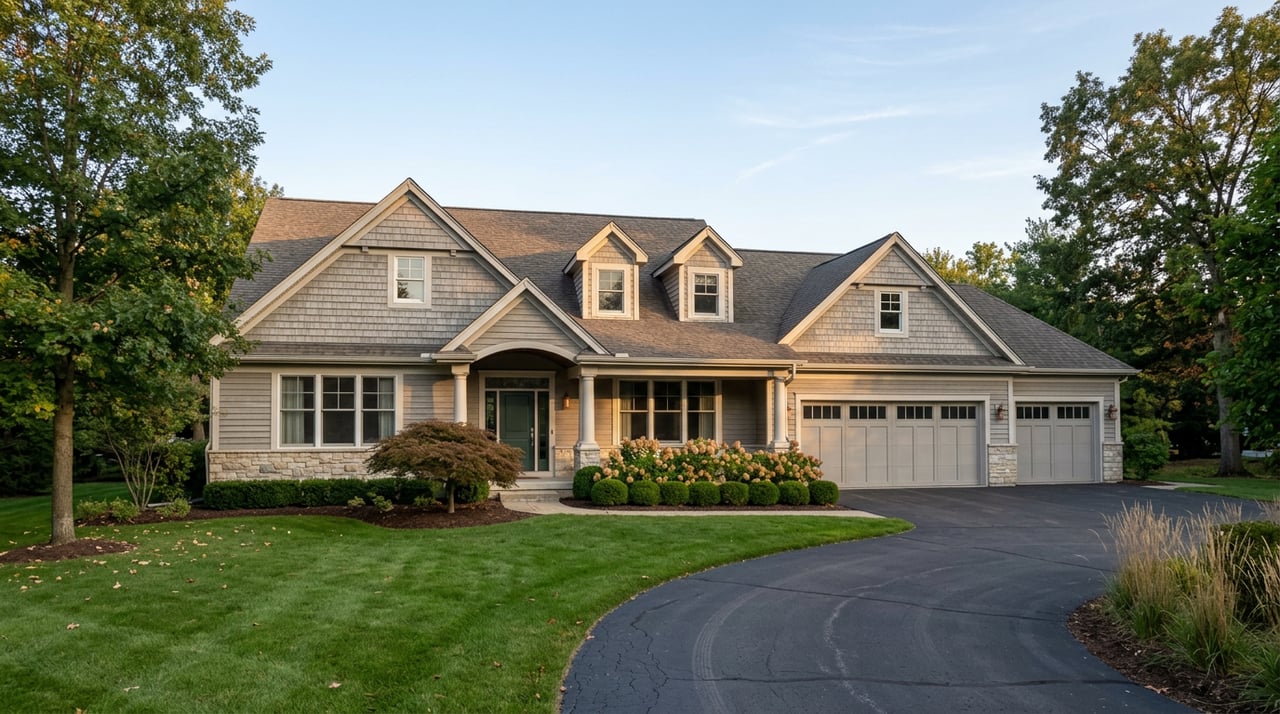
Pull up two listing sites for Symmes Township on the same afternoon and you will get two different stories. One will tell you the median sale price fell nearly 9% over the past year. The other will show active listings with a median price near $600,000 and homes going under contract in eight days, a 68% shorter time on market than a year earlier. They describe different measures from roughly the same period. Neither one is wrong. They are just describing different pieces of a place that only sounds like one place.
If you are cross-shopping Symmes Township against Mason, Loveland, or Montgomery right now, that difference in what the figures measure matters more than any single stat you have already bookmarked. Here is what is actually going on, and how to read the numbers so they tell you something useful.
Two Islands, One Name
Symmes Township is one of twelve townships in Hamilton County, established in 1822 and named for John Cleves Symmes, whose land purchase helped found Greater Cincinnati. Over the decades, Indian Hill, Loveland, and Montgomery have annexed large pieces of Symmes Township, especially Indian Hill. The result is a township that has literally been cut into two separate geographic islands, with unincorporated pockets like Camp Dennison and Sixteen Mile Stand sitting in between the annexed land.
That is not a footnote. It means when a listing says "Symmes Township," you are not looking at one contiguous neighborhood the way you would with Mason or Montgomery. You are looking at a label stretched across two disconnected patches of land, and the address on any given listing could sit closer to Indian Hill's estate lots or Loveland's river corridor than to any other property carrying the same township name.
Four School Districts, Five ZIP Codes
The fragmentation goes deeper than geography. Because of how the annexations landed, homes inside Symmes Township are zoned across four different school districts and mailed through five different ZIP codes.
| Layer | Count | Names |
|---|---|---|
| School districts | 4 | Indian Hill, Loveland, Little Miami, Sycamore Community |
| ZIP codes | 5 | 45111, 45140, 45147, 45242, 45249 |
A home a few streets away from another home in the same township can carry a different ZIP code and feed into a completely different school district. That is unusual even by Cincinnati suburban standards, where most townships and cities line up cleanly with one district and a handful of ZIP codes at most.
Symmes Township also runs its own kind of local government that reflects this piecemeal geography. It is overseen by a three-member elected board of trustees rather than a mayor, has no municipal police department of its own, and relies on the Hamilton County Sheriff for law enforcement while the Loveland-Symmes Fire Department handles fire coverage. None of that changes home values directly, but it is one more sign that "Symmes Township" behaves less like a single city and more like a set of neighboring pockets that share a name and a tax map.
Where the Contradiction in the Numbers Actually Comes From
Once you see the township as fragmented rather than uniform, the conflicting stats stop looking like a mistake and start looking like exactly what you would expect.
In May 2026, the townshipwide median sale price across all home types came in at $534,680, down 8.9% from the same month a year earlier. That figure blends everything that closed that month, whatever ZIP code or school district it happened to sit in. A month like that can easily be pulled down by a cluster of smaller resale homes closing in one pocket while larger new construction sat on the market a little longer elsewhere.
Compare that to the picture one month later. In June 2026, homes listed for sale in Symmes Township carried a median list price of $599,000, and the median time on market had dropped to just eight days, a 68% drop from June 2025. That is not a soft market. That is a market where the homes hitting the list have been priced to move and are getting snapped up fast, which is a very different signal than a falling median implies.
New construction adds a third layer. As of early September 2026, active new-construction listings in the township, including product from builders like Zian Homes working in the Montgomery-adjacent pocket, carried a median list price around $650,000, with most homes reportedly fielding roughly 25 offers and going under contract in about 34 days. That is a small, specific slice of the market, largely concentrated in newer subdivisions such as Walnut Grove Village, and it behaves nothing like the resale homes driving the townshipwide median down.
None of these three numbers is more "true" than the others. They are measuring three different slices of a township that was never one uniform market to begin with. The mistake is trusting whichever number loads first on your phone and assuming it applies to whatever specific address you are actually considering.
There is also a simple math reason these swings look dramatic. The 2020 Census counted 15,642 residents across roughly 6,001 housing units in the entire township, a population that had grown only slightly to an estimated 15,762 by 2026. With that few housing units total, a handful of closings at either end of the price range in any given month can move the reported median more than it would in a larger, more uniform city.
The Better Number to Compare
If the townshipwide median is unreliable, what should you actually look at? Square footage.
Across several current MLS-fed listing pages this year, average home sizes in Symmes Township consistently land somewhere between 2,900 and 3,200 square feet, well above the general county average that shows up in the same data closer to 1,800 to 1,950 square feet. That gap holds up across multiple independent listing feeds, which makes it a far more stable signal than a monthly median swinging on a handful of closings.
Put another way: whichever pocket of the township you end up looking at, you are likely comparing homes that run 900 to 1,300 square feet larger than a typical Hamilton County home. Active listing averages this year have also clustered in the $665,000 to $715,000 range, which lines up with that size difference more than it lines up with any single median-price headline. If a listing looks expensive relative to the townshipwide median, check the square footage first. It is often explaining the gap better than the ZIP code is.
The township's median household income also helps explain why homes run larger here. Census data put the figure at roughly $157,136, more than double the number for Hamilton County as a whole. That level of buying power tends to support bigger footprints and more custom or semi-custom construction, which is part of why builders like John Henry Homes have been active in the Indian Hill schools pocket of the township specifically.
What This Means If You're Comparing Symmes Township to Mason or Loveland
Before you weigh a Symmes Township listing against something in Mason or Loveland, get specific about which piece of Symmes Township you are actually looking at.
- Ask which school district the address feeds into. Indian Hill, Loveland, Little Miami, and Sycamore Community are not interchangeable, and a listing agent should be able to confirm this before you tour.
- Check the ZIP code against the five listed above. It tells you roughly which island of the township you are in, and by extension which annexed city's amenities and commute pattern you are actually closest to.
- Compare square footage and lot size before you compare the headline median. Given how much larger homes here run compared to the county average, price-per-square-foot is a more honest yardstick than a townshipwide median that blends new construction with decades-old resale stock.
- If you are drawn to the newer subdivisions, understand that recent list prices and offer counts in that segment can run well above what the townshipwide median suggests, because that segment is a small, fast-moving slice of a much larger and slower blended number.
None of this makes Symmes Township harder to buy into. It just means the usual shortcut of trusting one median price will not work here the way it does in a more geographically uniform suburb.
A Few Questions Worth Asking Directly
Is Symmes Township a city? No. It is an unincorporated township governed by a three-member board of trustees, with no municipal police department. The Hamilton County Sheriff provides police coverage and the Loveland-Symmes Fire Department covers fire service.
Why do I see different school districts listed for different Symmes Township addresses? Because the township's boundaries were reshaped by annexations from Indian Hill, Loveland, and Montgomery over the decades, leaving four different unified school districts, Indian Hill, Loveland, Little Miami, and Sycamore Community, serving different pockets of the same township.
Why does one site show falling prices and another show homes selling in eight days? Both can be true at once in a small, fragmented market. A townshipwide median blends every closing regardless of which pocket it came from, while active-listing metrics reflect only what is currently on the market, which can be a very different mix.
If you are trying to figure out which pocket of Symmes Township actually fits your budget, your commute, and the school district you want, a conversation with someone who tracks this market address by address is worth more than another portal search. Angel Apking works this corridor of northeast Cincinnati every day and can walk you through exactly which island, ZIP code, and district a specific listing falls into before you make an offer. Request a free home valuation to start the conversation with real numbers instead of a blended median.